
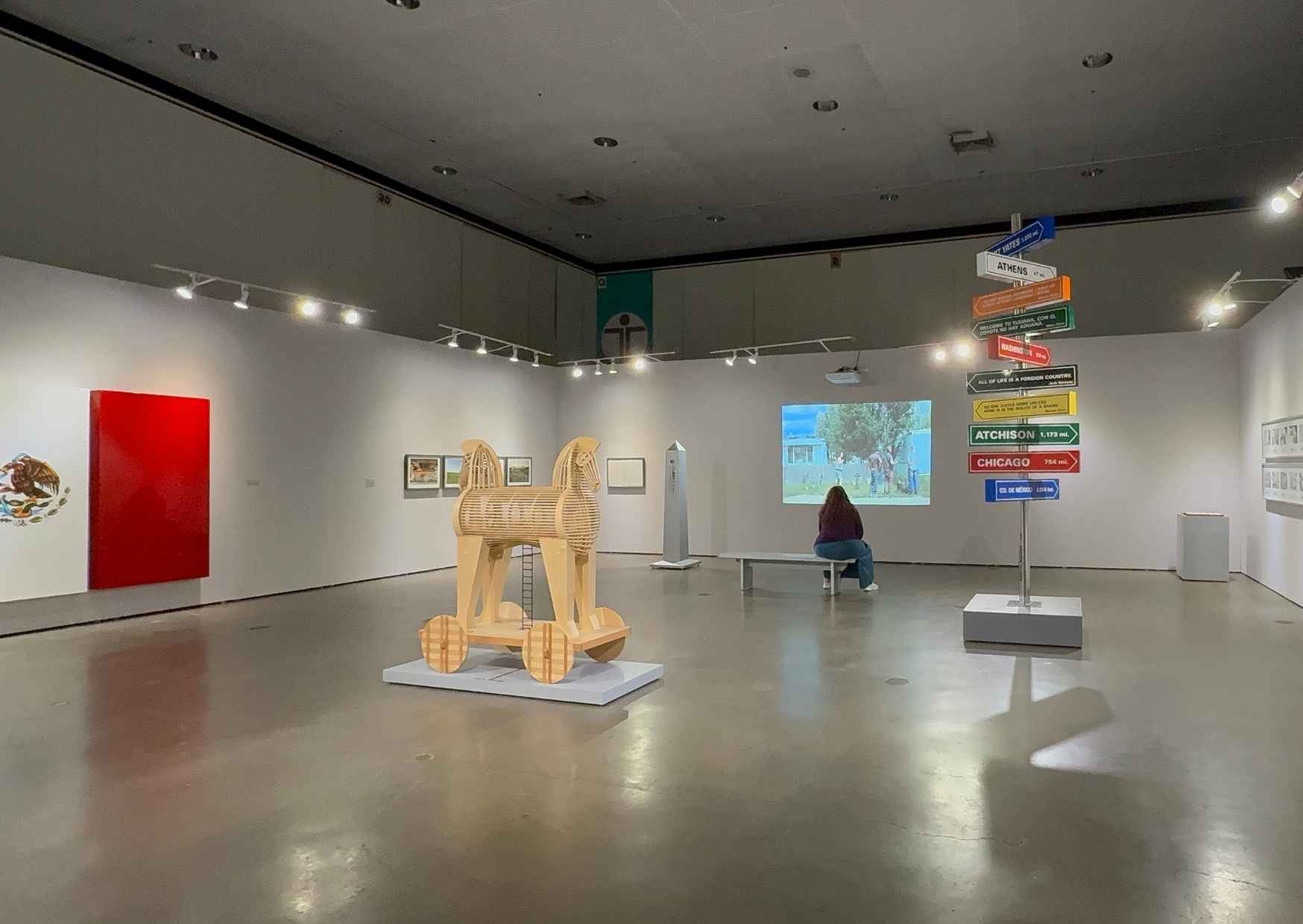
Centered on Los Angeles’s multicultural structure and its rising position within the global art scene, the LA Art Show took place between January 7–11, 2026, at the Los Angeles Convention Center. Spanning more than 180,000 square meters, the fair went beyond functioning as a purely commercial platform. Through its curated special sections, it rendered visible the current tendencies of contemporary art, while the opening party of the 31st edition was hosted by actress Sasha Pieterse.
At first glance, what stood out most was the exceptionally orderly fair architecture [00:27]. Booth intervals were precise and ideally proportioned, creating an experience that remained breathable even during peak visiting hours; most importantly, the circulation routes allowed visitors to engage with every stand. Comprising 70 galleries, 5 special exhibitions, 3 sponsors, and 7 biennials, LAAS demonstrated a notably professional approach to the presentation of artworks and their accompanying wall texts.
The event was also memorable for encountering works by Keith Haring, Salvador Dalí, and Andy Warhol, alongside the participation of numerous galleries from the United States, France, South Korea, and the United Kingdom.
At Steidel Contemporary [05:21], I encountered text-based works by Adam Greener, whom I had previously seen at other fairs. Greener is an artist whose practice originates in a lifelong habit of storytelling [of filling notebooks with sketches and notes during his childhood and school years]. Using large–scale materials that resemble torn notebook pages, he revisits the imagination, humor, and obsessions of childhood and adolescence through acrylic illustrations, questioning how a young mind interprets a chaotic world shaped by culture, rules, and social expectations.
Representing Switzerland, Laurent Marthaler Contemporary offered one of the fair’s most striking examples of artwork labeling, presented on aluminum plates [09:18]. Positioned near the entrance, the booth immediately captured attention with Daniel Allen Cohen’s Periodic Table of Luxury [09:37]. Conceived as a conceptual work, the piece employs the visual language of the scientific periodic table to examine the notion of luxury. Balancing between conceptual practice and a visual aesthetic that also appeals to mainstream contemporary art and collector habits, the work forms the most comprehensive and significant installment of the artist’s Periodic Table series. Recognizable luxury objects [ranging from vintage Chanel pearl necklaces to a roughly $900 bottle of Louis XIII cognac] are systematically arranged like chemical elements. By placing an inherently subjective and culturally constructed concept within a structure associated with scientific order and classification, Cohen creates a deliberate contradiction. Through this strategy, he exposes contemporary society’s obsession with status, consumption, and display. The Periodic Table of Luxury functions not merely as an aesthetic presentation, but as a critical work inviting viewers to reflect on the value, ‘necessity’, and social implications of luxury itself.
Perhaps because they were not structured around sales, the most intellectually engaging and conceptually ambitious section of the fair [18:12] was the biennials. Bringing together seven biennials and numerous interdisciplinary projects from across Africa, Asia, North and South America, and Europe, DiverseArtLA approached biennials not simply as exhibition formats, but as temporary laboratories where urgency, experimentation, and critical thought circulate. Within this framework, art institutions are positioned as structures that preserve the memory of these productions and ensure methodological continuity. Works addressing environmental crises, biometric data, ecological memory through textiles, digital landscapes, border politics, and nomadic curatorial models collectively demonstrated how contemporary art is being reshaped today around notions of place, community, technology, the body, and nature.
Presented by the New York–based Arcadia Contemporary [27:14], Matthew Cornell’s works function as a painterly diary of displacement, rootlessness, and the ongoing search for belonging that has defined the artist’s life since childhood. Although this type of practice does not usually fall within my primary interests, the meticulous details draw viewers toward the stand. Emerging from a childhood spent moving across the United States, these paintings shift away from idealized landscapes toward houses, neighborhoods, and the invisible lives unfolding within them. By favoring nighttime and twilight scenes, Cornell transforms ordinary structures into quiet narratives; light spilling from windows evokes both hope and a sense of absence. In this series, houses operate not merely as architectural forms, but as vessels of memory, continuity, and belonging. By contrasting the identity shaped by growing up in one place with his own fragmented past, the artist confronts the viewer with a fundamental question: is ‘home’ a location, or a feeling?
At Fabrik Projects [28:58], I encountered Dina Goldstein’s The Breakfast series. The work stands as a powerful example of the artist’s critical approach, which confronts popular culture icons with unsettling realities. Centering figures such as Barbie and Ken, emblematic of idealized Western culture, the scene exposes the fragility of domestic fantasies built on promises of perfect happiness. Through these symbols of childhood innocence, Goldstein reveals how beauty is framed as a prerequisite for power and fulfillment, how imposed roles generate identity crises, and how the ideal-life narrative inevitably collapses. The Breakfast strips away the glossy surface to expose emptiness and devaluation, confronting the viewer with both nostalgia and a sharp reckoning.
Pontone Gallery [29:21], South Korean artist Hwang Seontae’s practice unfolded through ‘light box’ works centered on the relationship between glass, light, and space [imbued with silence and anticipation]. Composed of layered printed and engraved glass surfaces illuminated from within, these works depict contemporary, orderly interiors. Light filtering through windows creates shadows and reflections within empty yet not abandoned rooms, generating both a sense of absence and an expectation of possible presence. The spaces are staged like theatrical sets in which action has been suspended and time appears to have stopped. Light becomes the principal actor, animating the static architecture and inviting the viewer into introspective contemplation, transforming everyday interiors into perceptual, meditative experiences.
At art fairs, one frequently encounters works that resemble individuals frantically pressing every button on an Atari console in order to win; attempting every popular trend within a single piece. Film characters, comic figures, epoxy gloss, oversized formats, and excessive coloration often converge in such works. Presenting these as original productions can feel somewhat absurd, as they effectively offer the audience a copy of a copy of a copy, packaged in the most marketable form. Variables such as a gallery’s caliber or poorly regulated artist booths largely determine whether one is exposed to this experience. At LAAS [as an event that adds vibrancy to Los Angeles] it was encouraging to encounter artists shaping the field beyond mainstream decorative habits; to see biennials functioning as balancing forces within the art ecosystem; and, despite inflated prices, to observe the diversification of video art practices [11:36 and 32:27], where screens were thoughtfully integrated into painterly and spatial contexts.
Erhan Us



Be First to Comment