

We had a pleasant conversation with young pianist Hamit Erdem Özpolat, who lives in Gaziantep, about his musical journey, piano education, and artistic path toward his dreams. Born in 2012 and still in middle school, Hamit has been taking piano lessons since the age of six and continues his disciplined studies with his teacher Renata Popovych. He is steadily developing his musical skills through solfège and master classes with distinguished artists and musicians whenever he has the opportunity. Despite his young age, his passion for music, eagerness to learn, and mature approach to art make him stand out on his classical music journey. In this interview, we discussed many topics, from his story of starting music to his stage experiences, his sense of discipline, and his future goals.
-Hello. First, we would like to get to know you briefly. Could you share your journey of starting music with us?
My name is Hamit Erdem Özpolat. I was born in 2012 in Gaziantep, where I still live, and I am currently in the 8th grade. I have been taking piano lessons from my teacher Renata Popovych since I was six years old. In addition, whenever I have the opportunity, I take solfège and master classes from valuable artists and musicians to improve myself and become more proficient at the piano. I am still continuing my piano education regularly with my teacher Renata.
My journey into music began partly thanks to favorable circumstances — I could even call it a coincidence. From a very young age, I was able to grasp basic skills such as reading, writing, and simple math, which are usually part of the first-grade curriculum. Because of this, my family and those around me thought I needed activities to keep me engaged before starting primary school. Since we already had a piano at home, my mother enrolled me in a piano course to keep me occupied during that period. My rapid progress caught the attention of my teachers and people around me, and that is how my long-term piano education journey with my teacher Renata began.

-It’s not easy to be a musician with professional discipline at such a young age. What has been the most challenging process for you, and how did you overcome it?
Actually, I still haven’t overcome it 😊 I’m still struggling. In general, I’m someone who doesn’t like sitting still. In fact, even though we had a piano at home, my family never thought I would one day play it, because they didn’t believe I could sit at the piano for more than five minutes — so it was a surprise for them too 😊
I can say that I’m very curious and versatile. I love playing football outside, riding a bike, traveling, watching F1 races, and learning new things. But practicing the piano takes up most of my time. To devote enough time to piano practice, I still have to motivate myself and make sacrifices from the other things I enjoy, and honestly, I find this really challenging. Still, my love for music enables me to make this commitment. I continue to work patiently to reach the level of discipline I know I need to have.
-How has the bond you’ve built with your piano teacher Renata Popovych, with whom you’ve worked for many years, contributed to your musical identity?
My teacher Renata is not only a teacher to me, but also a guide. Thanks to the years of education we’ve shared, our mutual understanding has allowed us to develop a very special bond. Of course, she has helped me progress greatly in music; she hasn’t only taught me how to play the piano well, but has also broadened my perspective on the piano and on classical music.
She is an idealistic teacher who wants the best for all her students. She has contributed so much to Gaziantep and to the musically talented children of this city. Thanks to the lessons I’ve received from her, I have won awards in many national and international competitions, and I was honored as Gaziantep’s Young Talent of 2020 by the Gaziantep Businessmen’s Association. I experienced many firsts with my teacher Renata, and the effort she has invested in me will never be forgotten. Her presence in this city is truly a great blessing for me and for her other students as well.

–Achieving near-perfect scores in international exams requires serious technical and mental preparation. Do you have a special study method you follow while preparing for exams?
First of all, as you can imagine, it requires a lot of hard work. There is an exam program provided to you, and the exams are conducted according to that program, which demands thorough preparation. For this, you need to have a very strong foundation beforehand. In addition, having a good command of English is extremely important. Of course, there can be help from interpreters, but the sentences you form yourself give the other party an idea of how involved you are in your work. Therefore, both your language skills and your exam preparation need to be solid.
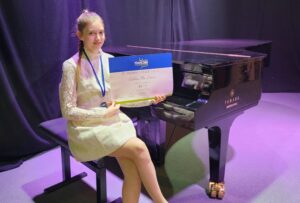
–What did your recording process for the 2023 ADS Winners album, in which you took part by interpreting a work by Frédéric Chopin, teach you in terms of studio experience?
Being able to record in such a studio at only 11 years old was an experience beyond my dreams. I felt as if the effort and dedication I had put in had truly paid off, and it became incredibly motivating for me to continue.
Sitting at that flawless piano there like a professional musician and making that recording makes you forget all the difficulties you’ve faced. If they are reading this, I would like to once again sincerely thank Gülsin Onay and Aras Deniz Sipahi for this valuable award.

–What kind of stage experience was it for a young artist to perform in Marmaris, Burdur, and Antalya with the Avdiyevski Sanat Fakültesi Oda Orkestrası, and what did these concerts add to you?
I was included in part of that tour upon my teacher Renata Popovych’s recommendation, and I’m grateful to her because she made one of my dreams come true.
I can say that this small tour, where I performed as a soloist with the orchestra in Marmaris, Burdur, and Antalya, has been one of the important milestones of my musical education so far. Through this mini tour, I gained many new experiences: teamwork, listening to other instruments while playing the piano, entering at the right moment when needed, and much more. However, to truly master and improve, these kinds of stage experiences need to be repeated again and again.
It was a deeply educational yet very joyful experience that disciplined me and filled me with happiness. With great desire and hope, I wish to perform with an orchestra again and again in the future.
–How has having your works published on digital platforms such as YouTube, Spotify, and Netd affected your ability to reach your target audience as a young artist interested in classical music?
I am still at the very beginning of my journey, a music student who hopes to become an artist if I succeed. However, as a classical music artist candidate who has been studying for seven years, I can say that classical music is a field with a very small audience, with relatively few listeners, and it requires great dedication. Unfortunately, it is very difficult to reach that audience with just a single recording or published piece. Still, through these kinds of recordings, we gain experience and learn how to take our next steps. It’s a long journey, and every new step brings us a little closer to that limited audience.

-I’ve heard that you’re interested in mythology. Do you think this interest contributes to your musical interpretation in terms of imagination or narrative power? Do you create a story in your mind while playing a piece?
My interest in mythology began years ago with a novel I read, and it has continued as I tried to understand that world more deeply by reading Homeros’s epics İlyada and Odysseia multiple times. As you know, their language is quite dense stylistically, and each time I read them I notice something new about mythological life. Of course, there are still many things I cannot fully interpret or that I don’t yet understand completely, but mythology is an exciting and entirely different world for me.
If we set myths aside and adapt them to real life, I think they are also very instructive both politically and psychologically. One day, when I compose a piece that truly satisfies me, this fascination with mythology may naturally be reflected in my music. However, for now, even if I sometimes really want to, it wouldn’t be considered appropriate to change the style of the works I perform; I should convey what the composer intended to express. As an aspiring artist, this is how I believe I should approach it.
–Finally, could you tell us about your future dreams or projects?
Future dreams… For every child who wants to move forward with classical music, this is a multifaceted matter. Briefly, if everything goes well, I would like to become a good virtuoso. But before anything else, we need to find a way to make classical music — whose audience is gradually decreasing — loved by wider audiences. The way to understand good music is through listening to classical music. Listening regularly to classical works, which are composed with all notes arranged in mathematical precision and near-perfect musicality, and trying to understand them actually increases the pleasure you feel when listening to songs in other genres as well, and it also brings a sense of selectiveness. In this way, I believe that bad music, regardless of genre, would naturally disappear.
It is necessary to instill this awareness in all music lovers so they demand good music and, through this, gain the highest possible enjoyment from whatever they listen to. As an example of a related project, it could be a good start in the future to propose adding courses on understanding and listening to classical music to school music curricula. As for my personal goal, my priority is to study at a good music school and reach the highest level in this field.







Be First to Comment