

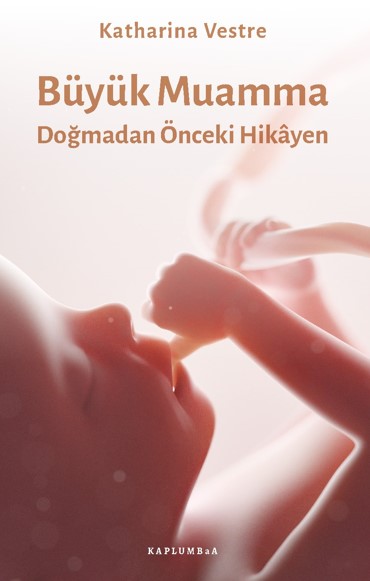
Katharina Vestre says “I wanted to write a fun and accessible book about the amazing story of how we develop in the womb,” and book called Büyük Muamma: Doğmadan Önceki Hikâyen, has been translated into 24 languages. It’s been a while since we actually did this interview. But there is a time for everything, now we are on the air. In fact, we can say that this is the exact equivalent of what this book is trying to convey. Interview with Katharina was so enjoyable that I couldn’t even ask half of what was on my mind. But it was a very delicious interview. All you have to do is enjoy it with a cup of coffee. And rest assured, you will be thinking a lot about our coming into the world. By the way, our author also has a surprise; children’s book, which he prepared with his sister, will soon be available in Turkish.
Enjoy reading…
AFTER STUDYING BIOLOGY, I STARTED LOOKING AT THE WORLD IN A DIFFERENT WAY
– Hi Katharina, how are you? It’s an interview yes, but I actually want to have a chat. I love asking this question: Tell us what kind of person you are? What should your readers know about you? Come on, tell us something interesting or funny about you.
Before studying biology, I went to a French course in Paris for fours months. I was known as the most clumsy person in class, so my friends got a bit worried when I told them I wanted to work in a lab!
The most precious thing I own is my banana plant, which I got from my friends when my book was first published in Norway. It has grown so much, my appartement in cold Oslo is turning into a jungle.
Also, I’ve won my family’s Christmas karaoke competition twice even though I can’t really sing well. I guess it’s thanks to my dorky dancing moves.
– Well, you’re actually a biologist, right? How did you decide to write a book?
I have always loved to read and write. When I studied biology, I was starting to miss that. We didn’t write much in my courses, except for lab reports. But then I found a science communication course at my university that gave me the opportunity to write about the most fascinating topics in biology. It was actually during that course I began writing a text that later would become my book. And now I am a teacher in the same course! I hope my students will have the same nice experience as I had.
– You started thinking about our how coming into the world when you were only six years old and you wrote a book about it. Are you a person who always thinks and produces on topics that he is curious about?
I think I am, yes. That’s what I love the most about working with science. After studying biology, I started looking at the world in a different way. When I look at my body, I think about all the hard-working cells it is made of. I imagine the immune cells crawling though my skin, the heart cells beating. And I love discussing the small and big mysteries of nature with my friends. Like, why are avocado pits so big? Why do men have nipples? We can go on and on, I love it.
– What was your ambition in writing this book?
I wanted to write a fun and accessible book about the amazing story of how we develop in the womb. After all, we all share this first chapter – it happened to all of us. My aim was that anyone should be able to understand this book, even my boyfriend who never studied biology and was not really sure what a cell is.
– So, will there be other such works? Are you preparing anything?
Yes! I am currently writing on a new book. I still need more time to work on it, but I can’t wait until I can tell you more about it! In the meantime, keep a look out for the children’s book I made with my sister. It will be published in Turkish in the near future!
YOUR BRAIN IS YOUR LIFE PROJECT
– You’re telling our story, before we were born. What was the most exciting and surprising information for you when you learned it?
I find it very fascinating how the brain develops. Despite it being one of the first things your cells start constructing, it is the last to be finished. Even at birth, it is far from complete. Actually, your brain is never completely finished. Everything you learn and remember leads to physical changes in the connections between your nerve cells. Your brain is your life project.
– Today, you are read in 24 languages. I am sure this book will be translated into many more languages. How does this situation make you feel? Are you surprised?
I was very surprised – I never even dreamed about it! It’s always so exciting to see my book out in the world, and to get feedback from international readers.
– Your book is a science book, but it does not tire. Did this subject compel you while writing?
I find this subject to be one of the most exciting mysteries in the world. But when you read scientific journals, they are often written in a complicated language that makes it hard to understand and appreciate the interesting topics they have researched. To be honest, scientific journals and textbooks can be quite boring to read. My aim was to write about these topics in a different way, using everyday words, comparisons and descriptions to make the science easier to understand. In this way, the science becomes entertaining and not tiring, I hope!
– You refer to the time when the sperm and egg meet as “race”. And our story actually begins exactly when this race is over, right?
Yes, as the sperm cell fuses with the egg cell, your very first cell is formed. And then, the mystery begins.
– Well, what happens in our mother’s womb after that?
First, the cells start dividing, turning into many identical round cells. İn a microscope, you look like a little raspberry. But soon the cells will start to change shape and become more and more different. I could go on, but I don’t want to give away everything in the book either.

IT IS TRUE THAT WE INHERIT OUR MITOCHONDRIA FROM OUR MOTHER, AND NOT FATHER
– I want to ask you something that has been on read before. Mitochondria come from the mother and energize the child. I read that this is just a mother to daughter transmission and that there is a genetic bond between the women of the family. What would you like to say about this?
It is true that we inherit our mitochondria from our mother, and not father. But it’s not only the girls that inherit them – boys need mitochondria too! The act as the powerhouses of the cells and provide us energy. So both daughters and sons will inherit the mitochondria form their mother. What is very cool about mitochondria is that they have their own genes. This is because they used to be bacteria that were taken up by a bigger cell! So it is true that there is a genetic bond from your mother, to your grandmother, great-grandmother-and so on. Their mitochondria have been passed on from generation to generation.
– You give the “Formula of the Human Race” in the book. The DNA helix carries all our life codes. It is a subject that affects people. Salvador Dali, for example, used the DNA helix in his paintings. What is the most magical thing in this formation process?
I find it magical that all the information needed to build a human being is contained within the DNA molecule. And that we are able to fit two metres of DNA into every tiny cell in our body!
– In the book you say that chemically the formula of a human is not much different from an oak tree. So, in a way, are we all brothers/sisters to oak trees?
Not exactly brothers and sisters. But it is true that we are veeeeeery distant relatives. In fact, every organism that lives on earth, be it a human, and oak tree or a fly, share a common history. We all originate from the first, primitive cells that arose on Earth. Through millions of years of evolution, these cells took different paths and we ended up with all the different life forms we have today. But where those very first cells came from? No one knows.
– How are our genders formed? What is the most interesting point of this process?
What I find fascinating is that it’s not until the third month that it is possible to see if the fetus is going to have a male or female body. In the beginning, there are no differences between the sexes. This is why boys have nipples – they are already in place before we become different. If the fetus has a Y chromosome, a gene on that chromosome will start the formation of testicles. The testicles will in turn make testosterone, which tells the cells that they should form a male body. Without these signals, the cells will automatically build a female body. This may sound simple, but it is actually a very complex process that depends on far more than just the Y chromosome. For example, if something is altered in this signaling process, a person could end up with a body that looks female on the outside, but that has a gland that behaves like a testicle on the inside.
– Katharina, somewhere (page 31) “The list of menstruating animals is pretty short. This list consists of humans, monkeys, and don’t ask why, but also bats,” you say. You say don’t ask, but I’m very curious why bats?
Haha! I’m glad I made you curious. No one knows for sure, but it might be because their placentas are similar to ours. In most mammals, the placenta just winds threads around the mother’s blood vessels without destroying them. But not in humans and bats. We dig deep into our mother’s womb and gain direct access to her blood supply. This is far more risky for the mother. Therefore, she will only allow a baby to grow in the womb if it sends out the right signals in time. Otherwise, she will get rid of the mucosa and have her period. That’s life – for us and for the bats.
– Thanks to your book, I now look at fruit flies differently. Well, besides what you wrote, what do you think about them as a biologist?
I also look at fruit flies differently after writing my book. It’s incredible that we share more than half our genes with these little insects. For a biologist, they are very useful because they reproduce fast and are easy to keep in the lab. But I have to admit that I didn’t like them very much when they invaded my kitchen last summer!

IF YOU ARE PREGNANT, CHOOSE THE MUSIC YOU LISTEN TO WISELY
– Of course, everything is a whole in the process of our creation, but shall we talk about our formation of intelligence? How is it?
The formation of our brain is what takes the longest time during our development. The outermost surface of the brain, which is responsible for the most advanced brain functions, is formed last. This part of the brain grows so large in humans that it must crinkle up in order to fit. That’s why our brains have the characteristic folded surface. However, during the first six months of development, our brains are smooth like the brain of a mouse. It’s not until the very end of foetal development that the more advanced parts of the brain are form, and the foetus can start to experience things.
– We know that a baby in the womb hears everything and feels everything, positive or negative. How that happening?
The foetus will start to react to sounds at some point during the sixth month. However, it can’t hear everything because many sounds are muted and distorted after passing through skin and muscle. Still, it seems that we are born with memories of the sounds we heard in womb. For example, newborn babies cry less and breathe more calmly if they can hear a heartbeat. And in one study, they found that babies would calm down when they played the melody of a soap opera that the mother was watching regularly while pregnant. So, if you are pregnant, choose the music you listen to wisely! It may become your life saver later when your baby is crying.
– So, who do you think decides which day we will be born; us or our mother?
It’s probably a combination, but if I have to vote for one I say the baby decides. We know that mouse fetuses create a signal in their lungs that helps start the birth. It is possible that something similar happens in humans, since it’s important that are lungs are ready to breathe as soon as we get out. Signals from the brain are also important for initiating birth. One thing is sure: at some point we really have to leave the womb, because there is no space for us to grow even bigger! I wish humans would give birth like kangaroos, it seems so much easier.
– Katharina, believe me, I can keep asking. There are so many things I want to talk to you about. But, of course I have to stop somewhere. Finally, do you have a message you would like to Turkish readers?
Thank you for a very nice talk Damla!
To my Turkish readers: Thank you for reading my book and I really hope you will enjoy it! If you want to get in touch, feel free to share pictures and tag me on Instagram. It’s so much fun to see my book out in the world!




Be First to Comment